
Restoring Performance in Desalination Plants
Reverse Osmosis (RO) and Multi-Stage Flash (MSF) desalination systems are the backbone of industrial and municipal water supply across the Eastern Province, and both technologies lose efficiency steadily as membranes foul, tubes scale, and mechanical components wear. A structured overhaul program — rather than reactive repairs — is what keeps these plants running at design capacity, protects capital equipment, and avoids unplanned shutdowns. Below is an overview of the key overhauling and maintenance work Zenixon Construction Company carries out on RO membrane systems and MSF trains.
Reverse Osmosis Membrane Overhauling
Hollow Fiber Membranes
Hollow fiber elements are still found in a number of older SWRO/BWRO trains and are widely used in ultrafiltration (UF) pretreatment stages. Rising differential pressure, declining normalized permeate flow, and increasing salt passage are the usual signs that an overhaul is due. Our scope typically covers extraction of the fiber bundles for inspection, checking for fiber breakage and bundle deformation, two-step chemical cleaning (acid cleaning to dissolve scale and metal oxides, alkaline cleaning to remove organic fouling and biofilm), replacement of O-rings and end caps, integrity testing by bubble or pressure-decay methods, re-potting of damaged fiber ends where feasible, and reassembly followed by a full performance verification run before the train is returned to service.
Spiral Wound Membranes
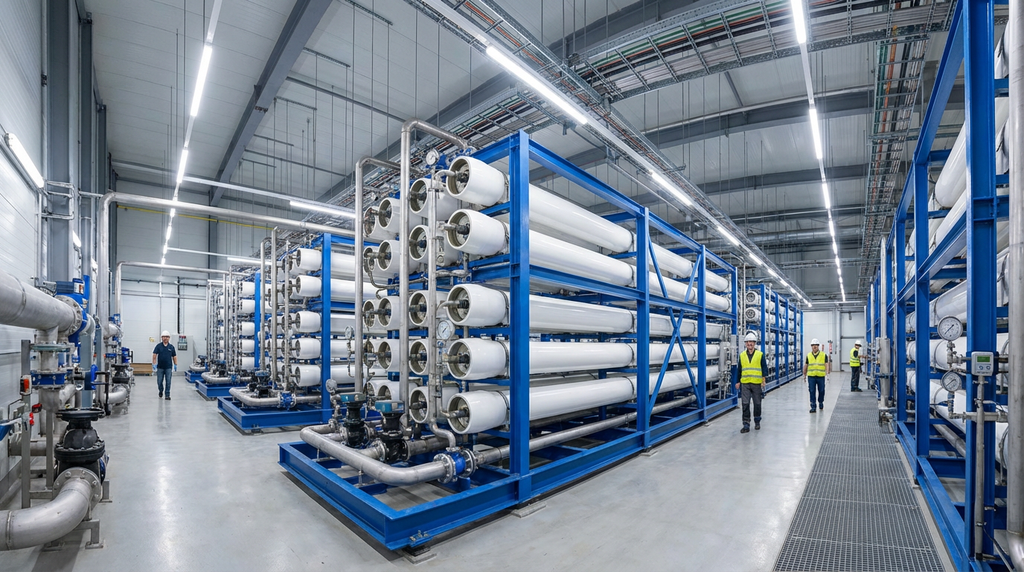
Spiral wound elements are the standard configuration in most modern RO plants, and their overhaul follows a similarly disciplined sequence: module extraction and visual inspection for telescoping and feed-spacer damage, brine seal replacement, membrane autopsy where fouling is suspected, staged CIP cleaning (low-pH for carbonate/sulfate scale, high-pH for organics and biological fouling), replacement of elements that have failed conductivity or flow testing, inspection of pressure vessels and interconnectors, and a normalized permeate flow and salt rejection test after cleaning to confirm the array has been restored to baseline performance.
MSF (Multi-Stage Flash) Overhauling
MSF trains involve rotating and static equipment across many flash stages, and a full overhaul generally addresses the following systems:
Demister — The wire-mesh pads that strip entrained brine droplets from the flashing vapor before it reaches the condenser tubes, preventing salt carryover into the distillate. Overhaul work includes removal and inspection for corrosion and scale blinding, replacement of degraded mesh sections, frame repair, and careful re-installation to eliminate any vapor bypass around the pad.
Anodes / cathodic protection — Sacrificial and impressed-current systems protect the carbon steel shell, water boxes, and tube sheets from seawater and brine corrosion. This work covers inspection of anode consumption rates, replacement of depleted sacrificial anodes, and testing and calibration of impressed-current systems and their electrical continuity.
Brine heater — The tube bundle that raises recirculating brine to the top brine temperature using steam, and one of the areas most prone to scale on the brine side and fouling on the steam side. Overhaul includes tube bundle extraction, mechanical and chemical descaling, tube plugging or replacement where tubes have failed, hydrostatic testing, water box and tube sheet inspection, and gasket and valve servicing.
Ball cleaning system — The online sponge-ball recirculation system that continuously scrubs condenser tubes to limit scale and biofouling buildup between shutdowns. Maintenance covers strainer and ball-collector cleaning, replacement of worn balls, overhaul of the ball injection and recirculation pumps, screen and basket cleaning, and confirming ball recovery rate is within the target range (typically above 90–95%).
Flash chamber — The vessel in which brine flashes to vapor across successive pressure stages. Overhaul work includes internal inspection for scale on the shell and weir plates, orifice cleaning, corrosion assessment of the shell and internal structures, coating and lining repair, and structural checks on the inter-stage partitions.
Condenser — The tube bundles that condense flashed vapor while preheating the recirculating brine. Overhaul includes mechanical or hydro-blast tube cleaning, tube leak testing (eddy current or hydrostatic), tube plugging, tube sheet and water box inspection, anti-corrosion coating touch-up, and gasket and expansion joint replacement.
Why a Planned Overhaul Program Matters
Left unaddressed, membrane fouling and MSF component degradation don’t just reduce output — they drive up energy consumption per cubic meter of product water, shorten equipment life, and increase the risk of an unplanned outage during peak demand. A planned, documented overhaul cycle, carried out by a team that understands both the mechanical and process side of desalination, keeps plants operating at their design efficiency and protects the client’s capital investment over the long term.