
Zenixon Construction · Civil Engineering · Ground Improvement
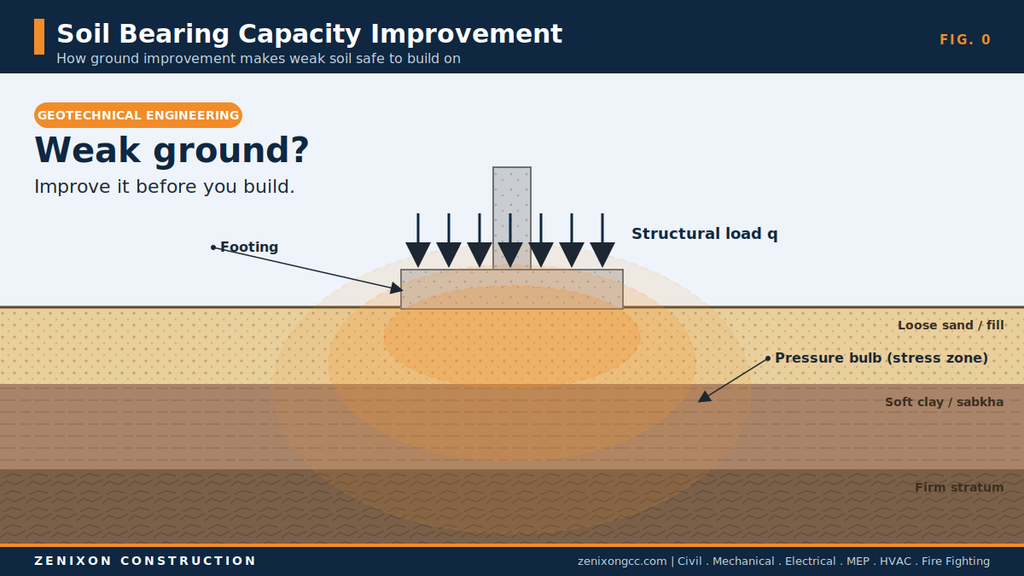
Every structure – a villa, a warehouse, a process plant or a water tank – eventually rests on soil. If that soil cannot carry the load, no amount of good concrete or steel above ground will save the building from excessive settlement, cracking or tilting. That is why soil bearing capacity improvement is one of the most important steps on any site with weak ground..
In the Eastern Province of Saudi Arabia, and around Jubail in particular, this is a daily reality. Loose aeolian sands, uncontrolled fills, high groundwater and sabkha (salt-flat) soils are common, and many sites simply don’t have the bearing capacity a design needs. The good news: weak ground can be engineered. This article explains the most widely used soil bearing capacity improvement techniques, where each one works best, and how to prove the result on site.
What Is Soil Bearing Capacity?
Bearing capacity is the maximum pressure the ground can support beneath a foundation without shear failure. Engineers work with the allowable bearing capacity – the ultimate value divided by a factor of safety (typically 2.5–3) and also limited by acceptable settlement, usually around 25 mm for isolated footings.
It depends mainly on:
- Soil type and strength – friction angle for sands, undrained shear strength for clays
- Density or consistency – loose sand and soft clay are the usual problems
- Groundwater level – a high water table can roughly halve the capacity of sands
- Foundation size and depth – wider and deeper foundations generally carry more
As a rough guide, loose sand or soft clay may offer only 50–100 kPa, while dense sand or stiff clay can provide 200–400 kPa or more. When the geotechnical report shows a gap between what the soil offers and what the structure needs, you have three options: redesign the foundation (wider footings, raft or piles), move the structure, or improve the ground.
Step One: Investigate Before You Improve
The right technique depends entirely on what is below the surface. A proper geotechnical investigation should include boreholes with Standard Penetration Tests (SPT), Cone Penetration Tests (CPT) where possible, groundwater readings, laboratory classification, and chemical tests for sulphates and chlorides – essential in sabkha areas, where aggressive salts attack concrete and steel. Improving the ground without this data is guessing, and guessing in geotechnics is expensive.
1. Soil Replacement and Compaction
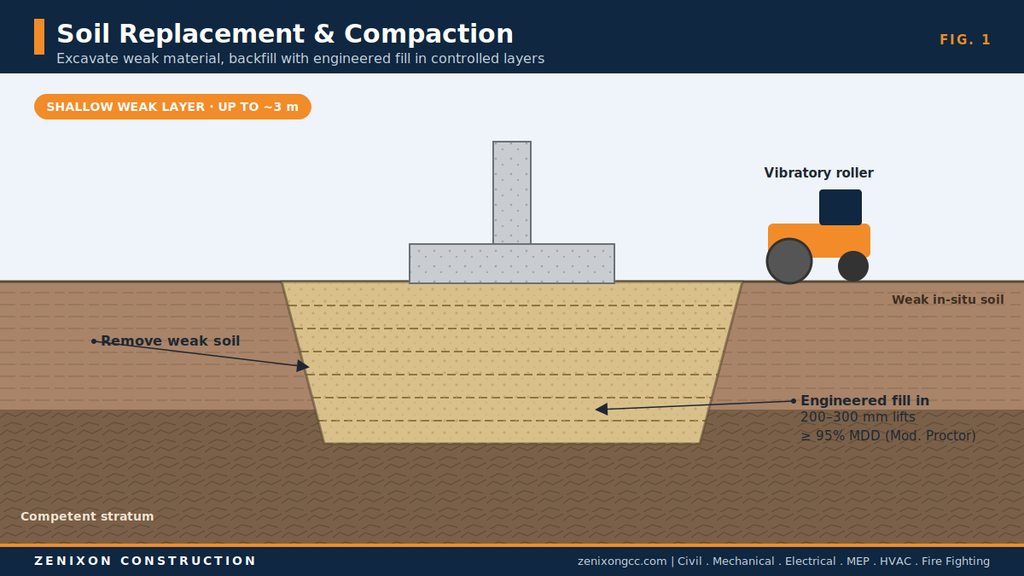
When the weak layer is shallow – typically up to about 2–3 m – the simplest and often cheapest solution is to dig it out and replace it with engineered fill: well-graded sand, gravel or crushed aggregate (for example subbase-type material).
- Fill is placed in lifts of 200–300 mm and compacted with vibratory rollers or plate compactors.
- Each layer is tested, usually to 95% of the Modified Proctor maximum dry density (ASTM D1557), using sand-cone or nuclear density gauges.
- Moisture content is kept close to optimum – critical in hot, dry climates where fill dries out quickly.
Best for: shallow loose sands, organic topsoil, rubbish or uncontrolled fill, and thin sabkha crusts. Watch out for: dewatering needs when excavating below the water table, and disposal of unsuitable material.
2. Dynamic Compaction
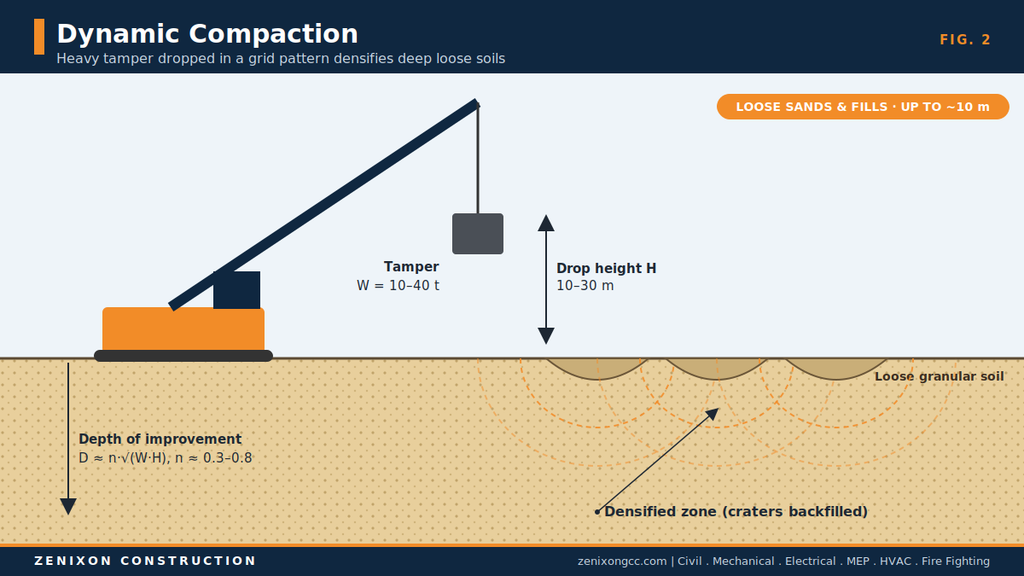
Dynamic compaction densifies deep deposits from the surface. A crane repeatedly drops a steel or concrete tamper of 10–40 tonnes from a height of 10–30 m on a grid pattern. The impact energy rearranges soil particles into a denser state.
The depth of improvement is commonly estimated as D ≈ n·√(W·H), where W is the tamper weight in tonnes, H the drop height in metres and n an empirical factor of about 0.3–0.8. In practice this means improvement to roughly 6–10 m.
Best for: large open sites with loose sands, reclaimed land and old fills – warehouses, laydown yards, industrial pads. Watch out for: strong vibrations (keep clear of existing buildings and buried services) and limited effect in saturated clays.
3. Vibro-Compaction and Stone Columns
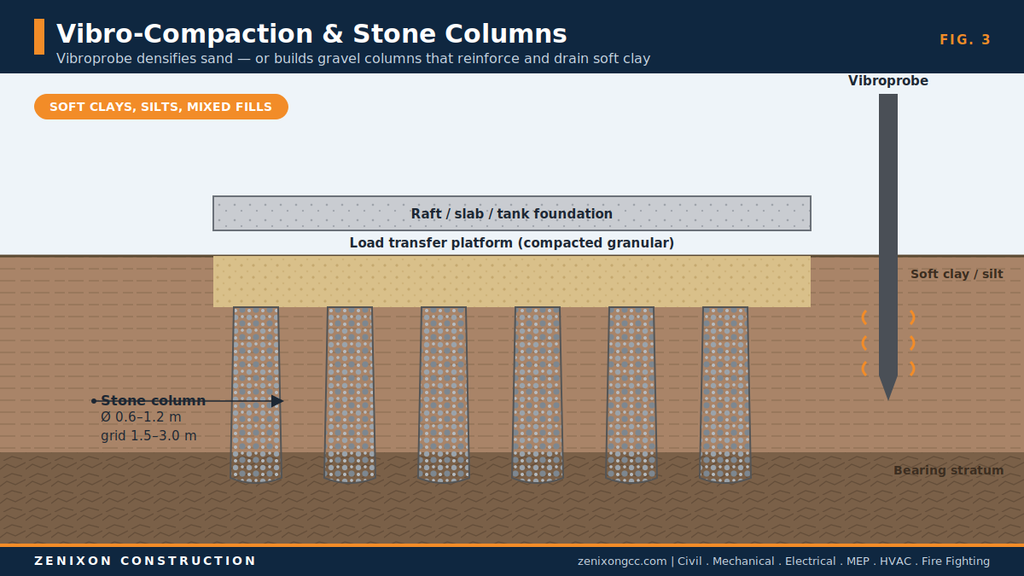
Both methods use a vibroprobe – a large, powerful vibrating poker lowered into the ground by crane.
- Vibro-compaction works in clean granular soils (fines content below about 10–15%). The vibration and water or air jetting rearrange sand grains into a much denser packing.
- Vibro-replacement (stone columns) is used where soils are too fine or soft to densify. Gravel is fed down the probe and compacted in stages, forming columns typically 0.6–1.2 m in diameter on a 1.5–3.0 m grid.
Stone columns do three jobs at once: they carry part of the load as stiff inclusions, they act as vertical drains that speed up consolidation, and they reduce liquefaction risk. A compacted granular load transfer platform is placed on top to spread foundation loads onto the columns.
Best for: storage tanks, embankments, raft foundations and industrial buildings on soft silts, clays and mixed fills.
4. Preloading with Prefabricated Vertical Drains (PVDs)
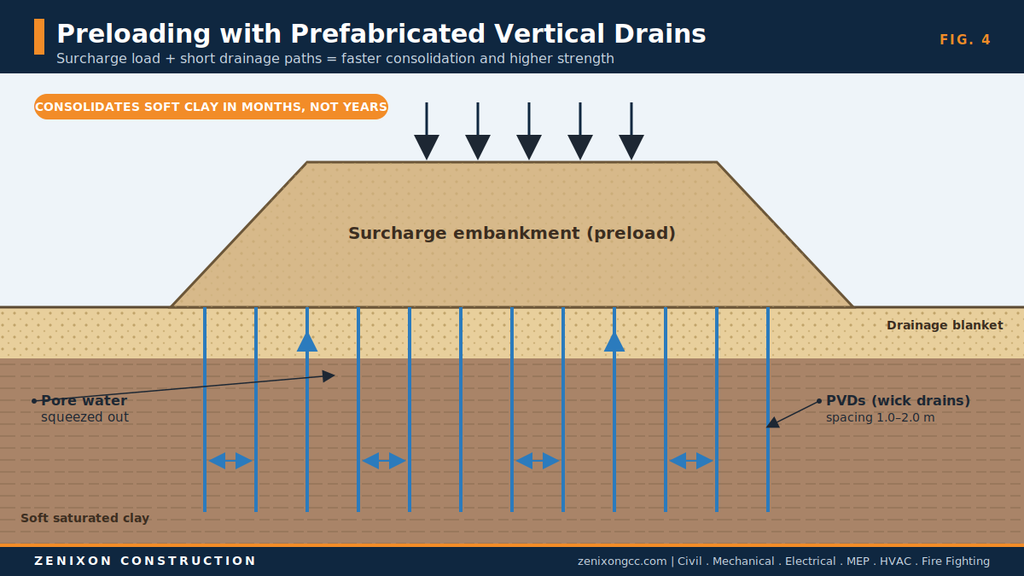
Soft saturated clays gain strength as water is squeezed out of them – but on their own, this can take years. Preloading places a temporary surcharge embankment on the site, often heavier than the future structure, so that most of the settlement happens before construction.
To speed this up, prefabricated vertical drains (wick drains) are installed at 1.0–2.0 m spacing. They shorten the drainage path from metres to centimetres, cutting consolidation time from years to a few months. A sand drainage blanket at the surface carries the expelled water away, and settlement plates and piezometers monitor progress until the target consolidation is reached.
Best for: large areas on soft clay – roads, tank farms, port and reclamation works – where there is time in the programme. Watch out for: the schedule; preloading needs months, so it must be planned early.
5. Grouting and Jet Grouting
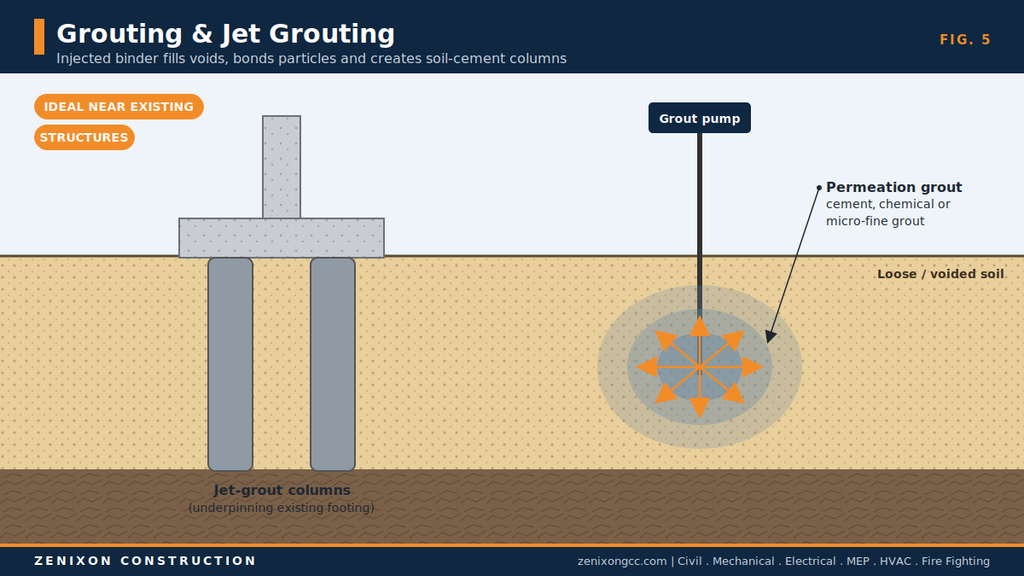
Grouting injects a binder into the ground under pressure. Main variants:
- Permeation grouting – cement, micro-fine cement or chemical grout fills pores in sands and gravels without disturbing the soil structure.
- Compaction grouting – a stiff grout displaces and densifies surrounding loose soil; useful for re-levelling settled structures.
- Jet grouting – high-pressure jets erode the soil and mix it with cement to form soil-cement columns of high strength, in almost any soil type.
Best for: underpinning existing foundations, work next to sensitive structures, filling cavities (including karst in limestone areas), and cut-off walls. It is more expensive per cubic metre, but it can go where heavy equipment and vibrations cannot.
6. Chemical Stabilisation (Lime and Cement)
Mixing lime or cement into the soil changes its chemistry and binds particles together. Lime (typically 3–6%) is effective in plastic clays, reducing swelling and improving workability; cement (typically 3–10%) suits sandy and silty soils. Deep soil mixing extends the same idea to columns several metres deep.
In sabkha and sulphate-rich soils, chemical stabilisation needs care: sulphates can react with calcium-based binders and cause heave, so laboratory trial mixes are a must before full-scale use.
7. Geosynthetic Reinforcement
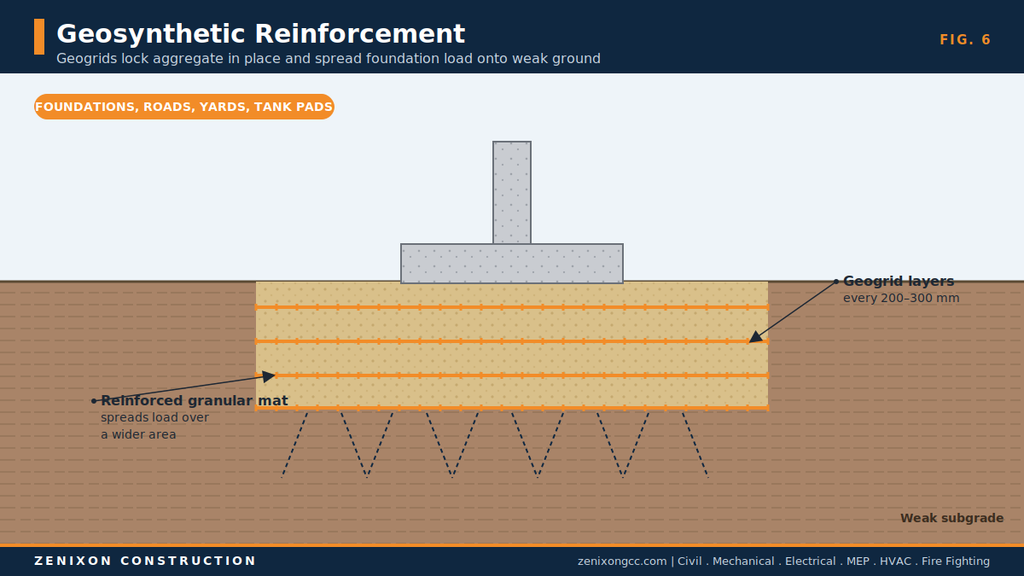
Geogrids and geotextiles placed within a compacted granular mat work like reinforcement in concrete. The geogrid interlocks with the aggregate, confines it and spreads the foundation load over a wider area of the weak soil below. Geotextiles also separate the fill from soft subgrade and prevent the two from mixing.
Best for: shallow foundations, roads, hardstands, equipment pads and tank foundations, often combined with partial soil replacement to reduce excavation depth.
Quick Comparison of Ground Improvement Techniques
| Technique | Suitable soils | Typical depth | Relative cost |
|---|---|---|---|
| Soil replacement & compaction | Any weak shallow layer | Up to ~3 m | Low |
| Dynamic compaction | Loose sands, fills | Up to ~10 m | Low–Medium |
| Vibro-compaction | Clean sands (<10–15% fines) | Up to ~20 m+ | Medium |
| Stone columns | Soft clays, silts, mixed fills | Up to ~15 m | Medium |
| Preloading + PVDs | Soft saturated clays | Up to ~30 m | Low–Medium (needs time) |
| Grouting / jet grouting | Most soils | Any, targeted | High |
| Lime / cement stabilisation | Clays, silty sands | Shallow (deep with DSM) | Low–Medium |
| Geosynthetic reinforcement | Weak subgrades | Shallow | Low |
Depths and costs are indicative only; the right choice always depends on site-specific geotechnical data and design loads.
Verification: Proving the Ground Is Ready
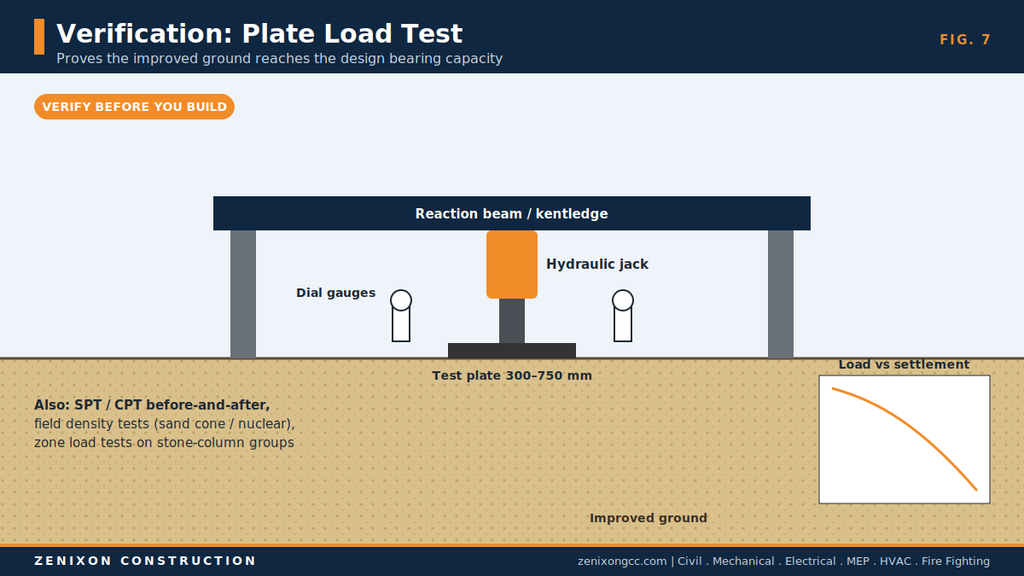
Ground improvement is only complete when it has been tested and documented. Common verification methods include:
- Plate load tests (ASTM D1194 / BS 1377-9) – a steel plate is loaded by a hydraulic jack against a reaction beam or kentledge, and settlement is recorded to confirm allowable bearing pressure.
- Before-and-after SPT or CPT – demonstrates the density gain with depth.
- Field density tests – sand cone or nuclear gauge for every compacted layer.
- Zone load tests – large-scale loading of stone-column groups for critical structures.
- Settlement monitoring – settlement plates and piezometers for preloading works.
Plate load test standard: the post cited ASTM D1194 for plate load tests, but ASTM withdrew that standard in 2003. That line now cites BS 1377-9 instead
How to Choose the Right Technique
The best solution balances four things: soil conditions, structural loads, programme and budget. A few practical rules of thumb:
- Weak layer shallow? Replace and compact – it is usually the most economical.
- Deep loose sand on an open site? Consider dynamic compaction or vibro-compaction.
- Soft clay under tanks or embankments? Look at stone columns or preloading with PVDs.
- Working next to existing buildings? Grouting avoids damaging vibrations.
- If improvement becomes more expensive than the alternative, a raft or piled foundation may be the better answer.
Comparing these options early – at tender or design stage – often saves far more than any later value-engineering exercise.
References:
| FHWA – Ground Modification Methods Manual, Vol. I | highways.dot.gov |
| FHWA – Ground Modification Methods Manual, Vol. II | fhwa.dot.gov |
| Saudi Building Code SBC 303 – Soils and Foundations | sbc.gov.sa |
| ASTM D1586 – Standard Penetration Test | astm.org |
| ASTM D1557 – Modified Proctor test | store.astm.org |
| Bearing capacity – Terzaghi’s theory | Wikipedia |
| Keller – Vibro replacement (stone columns) | keller-na.com |
| Menard – Dynamic compaction | menard-group.com |